Tom and Jules' Block Search
Bird BoxTom and Jules’s neighborhood search turns a practical expedition into a test of what the survivors can learn from the world beyond their covered house. Moving blindfolded from home to home, they find a husky, then another, and a group of birds; the animals offer possible help, but their behavior also exposes how little control the searchers have over the dangers around them. The return journey brings them back with resources and an idea, while the threat that follows the dogs’ usefulness remains unresolved.
Purpose and Conditions
The search takes place in a world where the housemates must remain blindfolded, and where a journey outside can make ordinary tasks hazardous. Tom has proposed protective helmets and butcher knives for a venture with dogs: the dogs might lead the men, but if one became dangerous, they would have to release it and defend themselves while blind. This plan makes the expedition an experiment in managing risk, not a straightforward outing. The men must depend on sound, touch, and the animals themselves to assess what lies nearby.
The larger household’s precautions make that dependence plain. Earlier, Cheryl waited inside the kitchen as a safety net while Felix went blindfolded to the well with a rope tied around his waist and a bucket selected to fit the well’s hooks. The procedure shows how danger is managed through partners, equipment, and careful movement rather than sight. On the neighborhood search, Tom and Jules carry that same logic beyond the home, where they cannot assume that a protected route or familiar structure will make a place safe.
A House, a Dog, and a Discovery
At one house, Jules directs Tom to a basement, where they find the parents lying on their backs in clothes that look suitable for church. Their clothing is torn at the shoulders, and a note on the mother’s chest bears the words “ReStiNg pEaCe.” Nearby, a boy is found; Tom identifies him as the person who arranged the parents there. The scene offers no clear account of how long the boy survived or what happened to the family. Jules observes that there is no food in the house and that he cannot tell what the boy lived on.
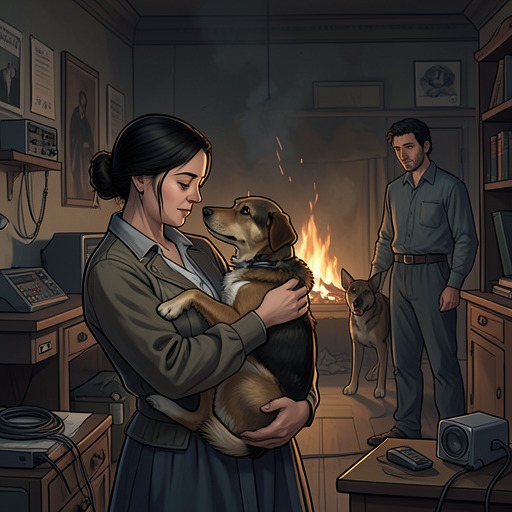
A husky is crouched among fur coats on a dress rack, severely underweight. Tom imagines that it may have been eating from the dead parents, but the possibility remains his inference. Jules tosses it meat from his duffel bag. The dog initially approaches slowly, then eats; Jules uses food and patient encouragement to build enough trust to bring it along. Tom searches the house as Jules works with the dog, but finds no phone book and no food, and little else they do not already have. Their hoped-for supplies are absent; their most important discovery is a living animal whose trust cannot be hurried.
Jules judges that the dog is not yet ready to leave, since it remains erratic and does not trust him. Though Tom had given the housemates twelve hours for their return, he accepts the delay: the afternoon has brought them a dog, and waiting may bring further discoveries. Once Jules manages to leash it, they leave the house blindfolded and helmeted. Tom uses a broomstick to feel his way, while Jules follows the panting husky. They continue farther from Malorie, Don, Cheryl, Felix, and Olympia, hoping another house will be suitable for the night if its windows are protected and there are no signs of death.
The Garage and the Birds
At another house, the first dog draws Jules’s attention to a freestanding garage, behaving as though something inside is alive. Tom, still unsettled by what they have found on the search, would rather continue home; Jules follows the clue. By touch, he discovers another husky. The second dog is less difficult to leash, and its presence changes the expedition’s yield: the men now have two dogs rather than one.
Tom also hears chirping near the garage. The sound first resembles children laughing, then a song, before he recognizes birds. He tests the sound by moving: when he backs away, the chirping quiets, and when he steps forward, it grows louder. The birds are located through this small change in volume rather than through sight. In a setting where visual inspection is forbidden, sound is both a warning and a means of discovery, but hearing the birds does not establish that the animals are safe or that they can be managed.
Tom decides to leave. Jules would prefer more time with the dog, but Tom says they can deal with the animals at home, locking them in a room if a problem arises. They have found what they set out to find, and he has an idea involving the birds. The evidence does not specify what the idea is. It does show that the search has shifted from gathering useful animals to considering how they might serve the household’s survival.
Return and Significance
The men retrieve the first husky and head back, each walking with a dog. They cross lawns and driveways until they reach the marker they set the day before, a practical reference point on a route made difficult by blindness. Before knocking, Tom hears the housemates arguing inside. He then thinks he hears something in the street behind him and turns toward it. The search therefore ends not in an uncomplicated return to safety but at a threshold where a new sound interrupts the men’s arrival.
The expedition’s results remain double-edged. The dogs can help guide blindfolded people, as Tom’s plan proposes, and their discovery gives Jules a reason to keep working with them. Yet their role as guides depends on trust and behavior that people cannot fully verify by sight. Later, Victor, the dog introduced to Malorie when she first enters the house, produces a growl she has never heard from a dog and strains violently against his tether. That episode does not establish that either husky from the search is Victor, but it underscores the risk built into the household’s reliance on animals.
Birds likewise resist a fixed role as dependable alarms or instruments. During Malorie’s river journey, she finds a tiny dead bird by touch and understands that birds in the sky are attacking one another. Set beside the birds Tom hears in the garage, this later discovery makes the animal life encountered during the search part of a wider, unstable world. The expedition brings practical possibilities home, but it cannot guarantee that animals will remain trustworthy guides, useful warnings, or even safe companions.